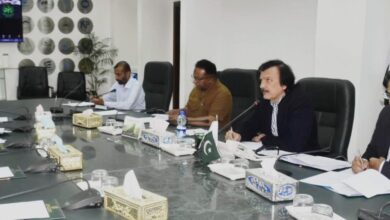
Islamabad: {May 15} Rendering to the news received from Jakarta, Indonesia, representing the Speaker of the National Assembly of Pakistan, Sardar Ayaz Sadiq, State Minister for Law & Justice, Barrister Aqeel Malik, addressed the 19th Session of the Parliamentary Union of the OIC Member States (PUIC), held in Jakarta, Indonesia.
State Minister Barrister Aqeel Malik expressed sincere appreciation to Ms. Puan Maharani, Speaker of the House of Representatives of Indonesia and Chairperson of the 19th PUIC Session. He thanked the Indonesian government for the excellent arrangements and hospitality extended to the Pakistani delegation.
The Minister of State, speaking on behalf of over 240 million Pakistanis and representing the voice of the world’s second-largest Muslim nation, underscored the pressing and multifaceted challenges confronting the Muslim Ummah. He pointed to rising external hostilities, internal discord, socio-economic exclusion, and cultural encroachments, as well as the scourges of poverty and disease that continue to afflict Muslim communities globally.
Barrister Aqeel Malik highlighted recent hostilities by India against Pakistan between May 6 and May 10, during which civilian populations and places of worship were reportedly targeted. He said that 31 innocent lives were lost and three mosques were razed in what he termed a series of unprovoked and cowardly airstrikes carried out under the cover of night.
He termed the strikes a dangerous escalation in regional hostilities and denounced what he described as India’s attempt to rationalize its actions through unfounded allegations and a purported false-flag operation.
In addition to military aggression, Barrister Aqeel Malik drew attention to India’s unilateral and unlawful decision to suspend the Indus Waters Treaty, a longstanding accord regulating the use of transboundary river systems since 1960. He warned that this move not only violates international law, but also poses an existential threat to Pakistan’s population and its agricultural economy.
Barrister Aqeel Malik further affirmed that Pakistan responded to the aggression with restraint and precision. Under “Operation Bunyanum-Marsoos” (The Iron Wall), the Pakistan Armed Forces reportedly downed six Indian aircraft, including Rafale jets, and neutralized several Israeli-manufactured suicide drones. He underscored that the response was guided by Islamic principles, deliberately avoiding civilian targets and focusing solely on military assets in stark contrast, he said, to India’s alleged disregard for international norms and human life.
He credited the success of the operation to the professionalism of Pakistan’s forces and the guidance of Quranic principles. He expressed deep appreciation to its allies and partners for their support during the recent escalation, with special acknowledgment extended to Muslim countries that stood in solidarity with Islamabad.
In his address, Barrister Aqeel Malik conveyed Pakistan’s “heartfelt gratitude” to its Muslim brethren, notably Türkiye, Saudi Arabia, Azerbaijan, Iran, the United Arab Emirates, and Qatar, for their steadfast support during the conflict and in the efforts leading to a ceasefire. He also thanked Bangladesh, Egypt, Algeria, Bahrain, Malaysia, and Palestine for their expressions of solidarity, making special mention of Indonesia recalling its historic support during the 1965 war under President Sukarno.
He went on to express “profound gratitude” to Pakistan’s longstanding strategic partner, the People’s Republic of China, for its consistent and unwavering support. The minister further acknowledged the constructive roles played by the United States, Russia, the United Kingdom, France, and the European Union in helping de-escalate tensions and facilitate a ceasefire.
Barrister Aqeel Malik warned that the world can no longer afford silence and that inaction would only encourage further aggression. He called upon the Muslim world to recognize that its lands are under attack — citing the destruction of Gaza, the mass killing and blinding of thousands in Kashmir, and the economic strangulation of several Muslim regions as examples of ongoing oppression.
He further exposed India’s involvement in supporting terrorism within Pakistan, referencing the March 11 attack on the Jaffar Express in Balochistan, where Indian-backed militants were involved in the killing of 31 civilians and law enforcement officers. He raised critical questions regarding India’s sheltering of terrorist leaders and its use of proxies like the BLA and TTP, reiterating the case of Kulbhushan Jadhav, an Indian intelligence operative previously caught orchestrating terror activities in Pakistan.
He stressed that Pakistan does not seek conflict but would resolutely defend its people, land, and sovereignty in accordance with the UN Charter and international law. He reiterated Pakistan’s political and moral support for the Kashmiri people in their rightful struggle for self-determination, as enshrined in UN and OIC resolutions.
In a call to action, Barrister Malik urged the PUIC to reaffirm its commitment to Kashmir’s right to self-determination, condemn unilateral changes made by India to the status of Jammu & Kashmir, and encourage a return to dialogue, diplomacy, and dignity as the path forward.
Quoting a Hadith of the Holy Prophet (PBUH), Barrister Aqeel Malik reminded members of the PUIC that “The Ummah is like one body; if one part suffers, the whole body feels the pain.” Concluding his address, he called for unity among Muslim nations, urging swift and collective action in the face of aggression and injustice. He stressed the need for a firm and coordinated response to safeguard the rights and dignity of oppressed Muslim communities across the globe.
#puic2025 #pakistanassembly #aqeelmalik #oicmemberstates #muslimunity #pakistanindiatensions #islamicwelfarestate #induswaterstreaty #regionalpeace #foreignaffairs #diplomaticrelations #humanrights #kashmirissue #globalawareness #internationalcooperation #defendingpakistan