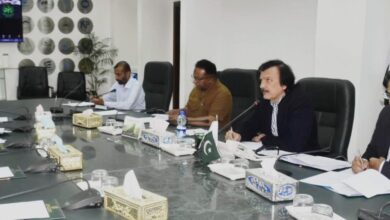
Islamabad, May 14, 2025: The creation of a complete Blue Economy Policy has been started by the Ministry of Maritime Affairs in an effort to fully realize Pakistan’s maritime industry’s potential to produce more than $100 billion a year.
Muhammad Junaid Anwar Chudhry, the Federal Minister for Maritime Affairs, chaired a high-level meeting and highlighted the economic opportunities the blue economy offers Pakistan. He also instructed the ministry to expedite the policy development process and stressed the significance of timely and inclusive policy formation.
“To ensure a collaborative, effective policy framework, all stakeholders, including relevant ministries, provincial governments, industry experts, and academic institutions, will be consulted,” the federal minister stated. “The blue economy is a priority for today, not a concept of the future.”
A sustainable use of ocean and marine resources to support economic growth, enhance livelihoods, generate employment, and preserve environmental sustainability while maintaining the health of ocean ecosystems is known as the “blue economy.”
According to federal minister Junaid Anwar Chaudhry, Pakistan’s present yearly contribution is about $1 billion, or 0.4% of the country’s GDP, but with complete optimization, it may reach over $100 billion.
“Maritime trade, coastal tourism, and fisheries are the main sources of this income. Notably, the federal minister continued, seafood exports bring in around $450 million annually, while maritime tourism brings in about $300 million.
According to projections, shipping may generate $8–10 billion in revenue, fisheries might generate $7–8 billion, aquaculture could generate $10 billion, and maritime tourism could generate $5–6 billion, the minister stated. Ship recycling, renewable ocean energy projects, and converting conventional ports into eco-friendly, sustainable “green ports” might all provide extra revenue.
According to Junaid Anwar, Pakistan is producing a far lower fraction of the $1.5 trillion that the blue economy provides internationally each year, which includes a wide range of industries like fisheries, shipping, tourism, offshore energy, and marine biotechnology.
Marine pollution, antiquated port and shipping technology, fragmented governance structures, a lack of research and innovation, and inadequate infrastructure are just a few of the structural and operational issues facing the maritime sector that Minister Junaid Anwar emphasized as urgently needing to be addressed.
“Our oceans are a national asset that, with proper management, can be a major source of job creation, economic growth, and environmental sustainability,” the minister stated. “We are dedicated to making sure that the Blue Economy Policy is in line with the Sustainable Development Goals and Pakistan’s Vision 2035.”
Leading marine specialists have already started to discuss it with the ministry, and a draft policy is anticipated shortly. The final report will include the institutional reforms, investment plans, and practical steps required to fully realize the economic potential of Pakistan’s maritime industry.
The Ministry of Maritime Affairs encourages all interested parties to actively contribute to the development of this significant policy, which will serve as the cornerstone of a sustainable economic future and fortify Pakistan’s strategy for effectively managing and expanding its ocean-based industries.
#MaritimePakistan #PakistanBlueEconomy #SustainableSeas #OceanEconomy #MaritimeGrowth #EcoPorts #MarineInnovation #PakistanShipping #BlueEconomyPolicy