


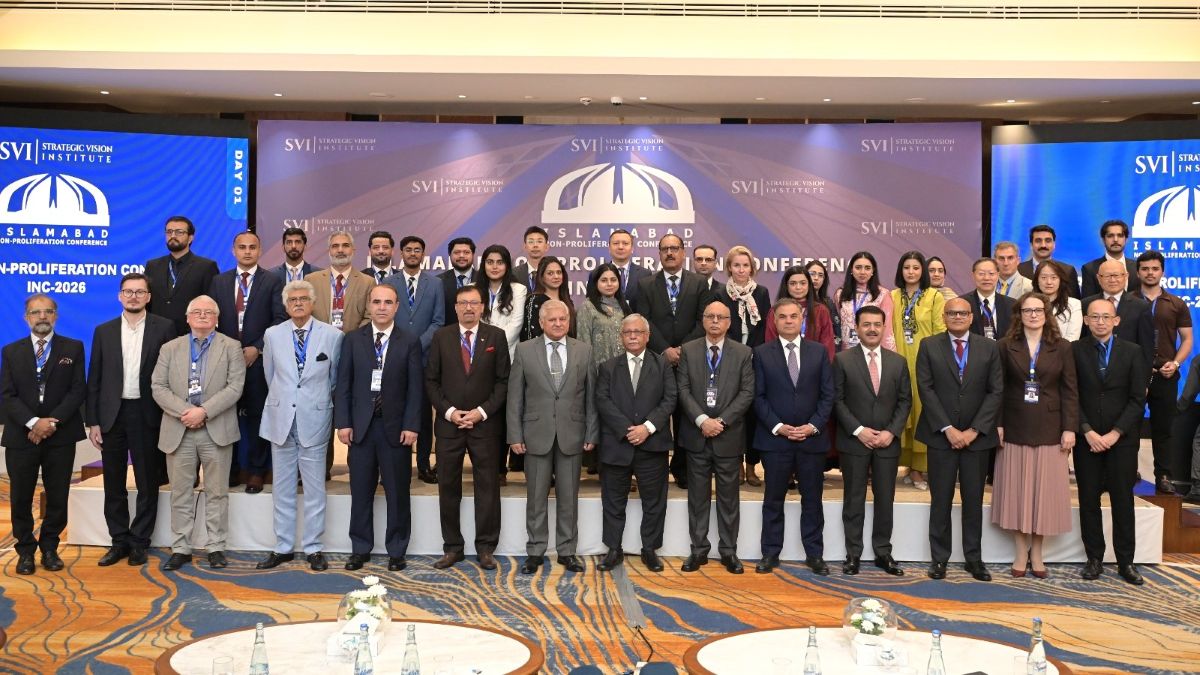
Islamabad – The Strategic Vision Institute (SVI), Islamabad, has convened the second iteration of the Islamabad Non-Proliferation Conference (INC) 2026. The two-day international assembly brings together a distinguished cohort of global scholars, security analysts, and policy experts to foster constructive dialogue on international strategic issues and articulate Pakistan’s national security perspectives.
SVI Convenes Landmark
Opening the conference, Dr Naeem Salik, Executive Director of SVI, welcomed delegates to INC 2026, followed by introductory remarks from SVI Director Dr Nasir Hafeez, who outlined the conference’s agenda within contemporary non-proliferation and regional security frameworks.
Addressing Emerging Threats to Global Non-Proliferation
Delivering the inaugural address, Lieutenant General Sarfraz Sattar (Retd), Advisor to the National Command Authority (NCA), observed that disruptive technologies are driving modern nuclear proliferation, directly challenging global disarmament efforts and long-term economic development.
Lt Gen Sattar noted a fundamental shift in the modern nuclear paradigm, where threat perceptions have evolved from non-state actors acquiring strategic assets toward heightened great power competition and interstate friction. Highlighting South Asia as a critical strategic focal point, he cautioned that ultranationalist political doctrines, such as the pursuit of Akhand Bharat, alongside a weakening global nuclear non-use taboo, place extreme strain on the international non-proliferation regime.
Full Spectrum Deterrence and Regional Balance
In his keynote address, Lieutenant General Khalid Ahmed Kidwai (Retd), Advisor Development to the NCA, provided a detailed assessment of Pakistan’s credible deterrence posture and strategic balance in South Asia. Analyzing developments surrounding the May 2025 conflict, Lt Gen Kidwai reiterated that Pakistan’s Full Spectrum Deterrence (FSD) framework remains defensive in character, designed to prevent conflict across all operational tiers and maintain regional stability.
Referencing the SIPRI Yearbook 2026 report regarding India’s operational deployment of approximately 12 nuclear warheads aboard ballistic missile submarines, Lt Gen Kidwai expressed concern over the lack of pre-notification protocols for submarine-launched ballistic missile (SLBM) tests. He underscored that such gaps increase miscalculation risks, challenge regional No-First-Use assertions, and compel Pakistan to maintain appropriate measures to safeguard its national security and preserve strategic equilibrium.
High-Level Working Sessions and Policy Output
To comprehensively analyze evolving security challenges, the conference features seven specialized working sessions. Agenda items focus on South Asian deterrence dynamics, escalation control, the changing structure of the global nuclear order, and the erosion of international arms control agreements. The conference will conclude with a valedictory address by General Zubair Mahmood Hayat (Retd), former Chairman of the Joint Chiefs of Staff Committee.
Highlighting strategic dialogue and international security developments underscores our editorial mission. Business Cafe is committed to reporting on policy, security, and global affairs that offer a platform for human development.